


It usually starts small. A little stiffness when you get out of bed. A dull ache by mid-afternoon that you blame on “just being on your feet too much.” Then one day, you’re standing in the kitchen, or walking your kids to school, or finishing a shift at work, and the pain in your foot is sharp enough that you have to stop and think about it.
If that sounds familiar, you’re not imagining it, and you’re not alone. Foot pain tied to poor arch support is one of the most common — and most under-treated — problems people live with for years, simply because they don’t know what’s actually causing it or how to fix it properly.
This guide walks through what’s really happening inside your foot, why the pain keeps coming back even after you’ve “tried everything,” and what actually works — based on how arches function, not guesswork.

Why This Pain Feels So Personal
Foot pain doesn’t just affect your feet. It changes how you move through your entire day. You start avoiding the walk you used to enjoy. You change your posture without noticing, which pulls at your knees and lower back. You feel more tired by evening, not because your day was harder, but because your body has been quietly compensating for hours.
That’s what makes arch support problems so frustrating — they rarely stay contained to just the foot. And because the pain builds gradually, it’s easy to normalize it, tell yourself it’s “just aging” or “just standing too much,” and keep pushing through instead of addressing the actual cause.
What’s Actually Happening Inside Your Foot
Your foot arch is made up of bones, ligaments, and tendons working together to distribute your body weight evenly with every step. When that structure is well-supported, the pressure spreads out and your foot absorbs shock efficiently. When it isn’t, pressure concentrates in specific spots — usually the heel, the ball of the foot, or the inner edge — and that repeated, uneven stress is what turns into pain, inflammation, and sometimes long-term joint issues.
This is why store-bought insoles or “just tougher shoes” often don’t help for long. They add cushioning, but cushioning alone doesn’t correct the underlying pressure imbalance.

The Three Arch Types — and Why Knowing Yours Changes Everything
Low / Flat Arch
The foot rolls inward with each step (overpronation), putting extra strain on the inner ankle, knee, and lower back. People with flat feet usually need firm, structured support rather than soft padding — soft cushioning alone tends to let the foot keep collapsing inward.
Neutral Arch
Weight distributes fairly evenly, but even a neutral arch loses support over time — from worn-out shoes, weight changes, pregnancy, aging, or long hours on hard floors. A “normal” arch is not immune to pain; it’s just often overlooked.
High Arch
A high, rigid arch doesn’t absorb shock well, so pressure concentrates hard on the heel and ball of the foot. This type is more prone to instability, ankle rolling, and needs both cushioning and a supportive heel cup — not one or the other.
Signs Your Current Support Isn’t Working
- Pain is worse first thing in the morning, eases slightly once you’re moving, then returns by evening
- Standing on tile or concrete floors hurts noticeably more than carpet
- One side of your shoe sole wears down faster than the other
- Pain travels upward into your knees, hips, or lower back after long periods on your feet
- You’ve started avoiding walks, errands, or activities you used to do without thinking twice
That last point matters more than people realize. When pain starts shaping your choices — what you do, how far you walk, whether you take the stairs — it’s no longer a minor inconvenience. It’s your body asking for a real fix.

What Actually Fixes Arch Support Problems
1. Match Your Insole to Your Actual Arch Type
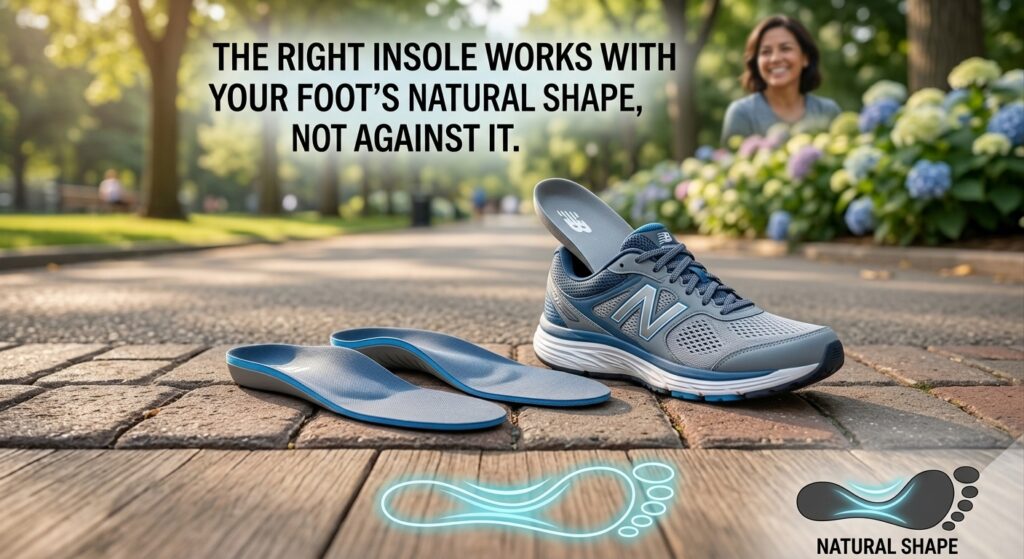
Not every insole works for every foot, and this is where most people go wrong — they buy whatever’s cheapest or most popular instead of what matches their arch height. A firm, contoured orthotic insole built for your specific arch corrects the imbalance instead of just padding over it temporarily.
2. Prioritize a Deep, Supportive Heel Cup
A well-designed heel cup keeps the heel centered and stable with every step, reducing the strain that would otherwise travel up through the ankle, knee, and lower back. This one detail is often the difference between an insole that “feels nice” and one that actually solves the problem.
3. Rotate Your Footwear
Wearing the same pair of shoes every single day wears down the support structure faster and doesn’t give materials time to recover their shape. Rotating between two or three supportive pairs extends how long your support actually stays effective.
4. Give It Real Time
This is the part people underestimate. Your foot has likely been compensating for months or years — it won’t fully readjust in two days. Most people notice a real, sustained difference within 2 to 4 weeks of consistent use, with continued improvement over 2 to 3 months as the surrounding muscles and tendons adapt.
When It’s More Than Just Arch Support
Sometimes the pain isn’t just about missing support — it’s a sign of something that needs direct attention, such as plantar fasciitis, tendonitis, or a structural issue in the foot. If you notice any of the following, it’s time to see a podiatrist rather than trying to fix it with insoles alone:
- Pain that persists for more than 4–6 weeks despite better footwear and support
- Swelling, redness, or warmth in the foot
- Numbness or tingling
- Sharp, stabbing pain with every single step, not just after long activity
There’s no reward for pushing through pain that’s trying to tell you something. A short visit to a professional can save months of guessing.
Frequently Asked Questions
How do I know what type of arch I have?
A simple way to check at home is the “wet footprint test”: wet the bottom of your foot and step onto a paper bag or dark pavement. If you see almost the full footprint, you likely have a low/flat arch. If you see only the heel, the ball, and a thin outer strip, you likely have a high arch. Anything in between is generally a neutral arch.
Can arch support problems go away on their own?
Mild, occasional discomfort can ease with rest, but ongoing pain caused by structural pressure imbalance typically doesn’t resolve on its own — it tends to worsen gradually as the body keeps compensating. Addressing the support issue directly is usually what breaks the cycle.
Are expensive insoles always better?
Not necessarily. Price matters less than fit. An insole that matches your specific arch type and provides a firm heel cup will outperform a more expensive one that doesn’t fit your foot shape correctly.
Final Takeaway
Foot pain isn’t something you have to quietly live with, and it isn’t a normal cost of getting older or being on your feet for work. In almost every case, it’s your body flagging a real, fixable mismatch between your arch type and the support you’re giving it. Identify your arch type, choose support built specifically for it, and give your feet the time they genuinely need to adjust. The pain usually follows — and so does the freedom to move through your day without thinking about your feet again.
This guide is based on general podiatric principles around foot arch mechanics and pressure distribution, and is intended for informational purposes. It isn’t a substitute for a diagnosis — if pain persists, please consult a podiatrist or foot specialist.