


Disclosure: This article contains affiliate links. If you buy through them, we may earn a small commission at no extra cost to you. We only recommend products we believe are genuinely useful.
Few fashion choices are as iconic as a pair of high heels. They lengthen the leg, change your posture and add instant polish to an outfit. But behind that elegant silhouette, your body is working in an unnatural position, and one structure takes the brunt of it: the Achilles tendon.
If you have ever kicked off your heels at the end of the day with a tight, aching calf or a sore spot just above your heel bone, this is not a coincidence. In this guide we explain the impact of high heels on the Achilles tendon in plain language: what changes inside your leg, which problems can develop, the warning signs to watch for, and practical ways to keep wearing the shoes you love with less risk.

Table of Contents
- What Is the Achilles Tendon and Why Does It Matter?
- What High Heels Do to Your Achilles Tendon
- Common Achilles Problems Linked to High Heels
- Does Heel Height Matter?
- Warning Signs You Should Not Ignore
- How to Protect Your Achilles Tendon
- 3 Simple Stretches for Heel Wearers
- Products That Can Help
- When to See a Doctor
- Frequently Asked Questions
- Final Thoughts
What Is the Achilles Tendon and Why Does It Matter?
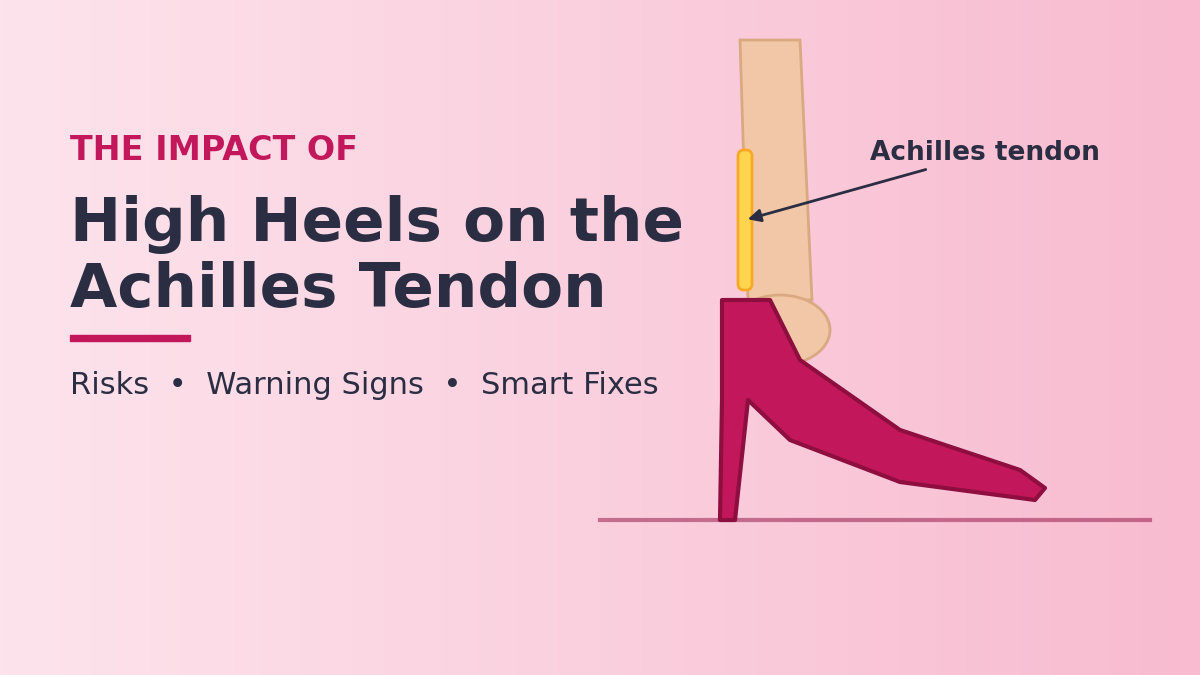
The Achilles tendon is the thick, rope-like band at the back of your ankle. It connects your two main calf muscles (the gastrocnemius and the soleus) to the heel bone (calcaneus). It is the strongest tendon in the human body, and it handles forces several times your body weight when you walk, run and jump.
Every time you push off the ground, the calf muscles pull on the Achilles tendon, which pulls on the heel and lifts your body forward. Because it works so hard every day, anything that changes the length, tension or angle of this tendon can affect how comfortably, and how safely, you move.

What High Heels Do to Your Achilles Tendon
When you step into a heel, your foot is forced into a position called plantarflexion, which is the same position as standing on tiptoe. The higher the heel, the more extreme that position becomes. Here is what happens over time.
1. The calf muscle-tendon unit stays shortened
In flat shoes, the calf and Achilles tendon are stretched slightly with every step. In high heels, they stay in a shortened position for hours. Research on women who wear heels regularly has found that their calf muscle fibers can become measurably shorter than those of women who mostly wear flat shoes, which is the body’s way of adapting to the position it spends the most time in.
2. The tendon becomes stiffer
To compensate for shorter muscle fibers, the Achilles tendon itself tends to adapt, often becoming stiffer. A stiffer tendon is less able to absorb and release energy smoothly, and this can make walking in flat shoes feel awkward, tight or even painful for habitual heel wearers.
3. Walking becomes less efficient
Studies of heel wearers show that the calf muscles have to work harder and in a different way to move the body forward. Over many months and years, this extra workload can add to fatigue and strain in the tendon.
4. Pressure at the back of the heel increases
The rigid back of many dress shoes (called the heel counter) rubs against the bone and tendon area at the back of the heel. Repeated friction can irritate the tendon, the nearby bursa (a small fluid-filled cushion) and the bone itself.

Common Achilles Problems Linked to High Heels
Not everyone who wears heels will develop problems, but regular use raises the risk of several conditions that affect the back of the heel:
- Achilles tendinopathy (tendinitis): Pain, stiffness and swelling in the tendon, usually worst in the morning or after activity. It develops from repeated overload and is one of the most common causes of heel pain.
- Retrocalcaneal bursitis: Inflammation of the small cushion between the Achilles tendon and the heel bone. It causes tenderness and swelling at the back of the heel, especially when shoes press on the area.
- Haglund’s deformity (“pump bump”): A bony bump on the back of the heel. The name “pump bump” comes from the way pump-style shoes rub against the area and irritate it.
- Calf tightness and cramps: A shortened calf muscle often feels tight and may cramp, especially at night.
- Increased strain when switching to flat shoes: After long periods in heels, the sudden stretch in flats can overload an adapted, stiffer tendon and lead to soreness.
- Tendon tears (less common): A tendon that is chronically overloaded, tight and inflamed is more vulnerable to partial or complete rupture, particularly with sudden, forceful movements.
Does Heel Height Matter?
Yes. In general, the higher the heel, the greater the change in ankle position and the more the calf and Achilles tendon are shortened. Very high heels and thin stiletto heels also reduce stability, which makes the ankle work harder to keep you balanced.
A simple rule of thumb many foot-health professionals follow is to keep everyday heels low to moderate (roughly under 2 inches, or about 5 cm) and to save the tallest pairs for short occasions. Wider heels and block heels spread pressure more evenly than stilettos, and a cushioned inner sole can reduce impact. Remember that how often and how long you wear heels matters just as much as the height itself.
Warning Signs You Should Not Ignore
Your body usually sends early signals before a real problem develops. Pay attention if you notice:
- Pain or stiffness at the back of the heel or just above it, especially first thing in the morning
- A tight, sore calf that does not ease after resting
- Swelling, warmth or redness around the back of the heel
- A visible or tender bump where the shoe rubs
- Pain when walking barefoot or in flat shoes
- A thickened or “lumpy” feeling in the tendon
Catching these signs early makes treatment much easier and helps you avoid long-term damage.
How to Protect Your Achilles Tendon
You do not have to give up heels completely. A few smart habits can significantly lower the strain:
- Limit wearing time. Wear heels for the event, not the whole day. Carry comfortable flats for commuting and long walks.
- Choose a lower, wider heel. A block or wedge heel under about 2 inches is far kinder to your tendon than a tall stiletto.
- Alternate your shoe heights. Varying heel height through the week stops the calf from adapting to one fixed position.
- Check the heel counter. Look for soft padding at the back of the shoe so the edge does not dig into the tendon.
- Stretch every day. Gentle calf stretching is the single most effective habit for heel wearers (see below).
- Strengthen your calves and ankles. Strong, flexible muscles share the load and protect the tendon.
- Do not go straight from tall heels to barefoot. Ease the transition with supportive flat shoes or cushioned slippers.

3 Simple Stretches for Heel Wearers
Do these stretches after you take your shoes off, ideally once or twice a day. Move slowly and stop if you feel sharp pain. A mild pulling sensation is normal.
1. Standing wall calf stretch
Stand facing a wall with one foot back, heel flat on the floor and back leg straight. Lean forward until you feel a stretch in the upper calf. Hold for 30 seconds, then repeat 2 to 3 times per leg.
2. Bent-knee soleus stretch
From the same position, bend the back knee slightly while keeping the heel down. You will feel the stretch lower in the calf, closer to the Achilles tendon. Hold for 30 seconds, repeat 2 to 3 times per leg.
3. Step heel drop
Stand on the edge of a step with your heels hanging off. Slowly lower your heels below the level of the step, then rise back up. Do 10 to 15 slow repetitions. If you already have Achilles pain, check with a healthcare professional before starting this exercise.

Products That Can Help
The right accessories will not undo the effects of very high heels, but they can reduce friction, support healthy flexibility and make recovery easier. Here are the types of products that are especially useful for heel wearers.
Gel Heel Pads / Heel Grips
Soft gel pads sit inside the back of the shoe and cushion the area where the heel counter rubs. They are a simple, low-cost way to reduce irritation and help prevent pump bumps and bursitis.
Slant Board / Calf Stretcher
A slant board holds your feet at a comfortable angle so you can stretch the calves and Achilles tendon hands-free. It is ideal for a few minutes of daily stretching at home or at your desk.
Cushioned Insoles for Heels
Padded insoles absorb shock and ease pressure on the ball of the foot, helping you stay balanced and reducing overall fatigue in the leg during long events.
Foam Roller or Massage Ball
Self-massage on the calf muscles after a day in heels helps release tension that would otherwise pull on the Achilles tendon.
Supportive Low Block-Heel Shoes
If you wear heels often, having a few pairs of low, wide block heels with a padded heel counter gives your Achilles tendon a break without sacrificing style.
When to See a Doctor
See a doctor, podiatrist or physiotherapist if:
- Heel or tendon pain lasts more than a couple of weeks
- You have noticeable swelling, a growing bump or trouble walking
- Pain is getting worse instead of better with rest
Seek urgent medical care if you feel a sudden “pop” or sharp pain at the back of the ankle, or you cannot push off your foot or stand on tiptoe. These can be signs of an Achilles tendon rupture, which needs prompt treatment.
Frequently Asked Questions
Can wearing high heels permanently damage the Achilles tendon?
Regular, long-term use of high heels can cause lasting changes, such as a shortened calf muscle-tendon unit and a stiffer tendon. Many of these changes can improve with less heel use, stretching and strengthening, but persistent problems should be assessed by a professional.
Why does my Achilles hurt when I take my heels off?
After hours in a shortened position, the calf and tendon are suddenly stretched when you switch to flat shoes or go barefoot. This can feel tight or sore, especially if the tendon has adapted to the heel position.
Are wedges better than stilettos for the Achilles tendon?
Wedges and block heels spread pressure more evenly and are more stable, but the heel height still keeps the calf shortened. A lower heel is better regardless of style.
How long can I safely wear high heels?
There is no exact time limit that suits everyone, but shorter wear, lower heels and regular breaks are all protective. Wear them for specific occasions rather than all day, every day.
Can I reverse the effects of high heels on my tendon?
For many people, yes. Reducing heel height and wearing time, stretching daily and strengthening the calves can help restore flexibility over time. If you have pain, get a proper assessment.
Final Thoughts
The impact of high heels on the Achilles tendon is real, but it is also manageable. High heels keep the calf and tendon shortened, which can lead to tightness, stiffness, heel pain and, over time, conditions such as Achilles tendinopathy, bursitis and pump bumps. The good news is that smart choices go a long way: lower and wider heels, limited wearing time, daily stretching and the right supportive products can protect your tendon and keep you comfortable.
Listen to your body. If your heels start to hurt, take it as a signal to ease off and give your Achilles the care it deserves. Your feet carry you through every day, so look after them.
Medical disclaimer: This article is for general information only and is not a substitute for professional medical advice, diagnosis or treatment. Always consult a qualified healthcare provider about any pain or health concern.